AllStarLink Net Schedules

Philippine AllStarLink System NODE # 440330
SUNDAY
10:00 AM PHT / 02:00 AM UTC

District 1

DX1ARC NODE # 534920
MONDAY to SATURDAY
08:00 PM PHT / 12:00 PM UTC

DX1ARM NODE # 537090
MONDAY, WEDNESDAY and SATURDAY
08:00 PM PHT / 12:00 PM UTC

DX1CW NODE # 531431
MONDAY to SATURDAY
07:30 PM PHT / 11:30 AM UTC

District 2

PH District 2 NODE # 43638
MONDAY
11:00 AM PHT / 03:00 AM UTC

DX2ACV NODE # 43633
TUESDAY
11:00 AM PHT / 03:00 AM UTC

District 3

DX3CA NODE # 51870
TUESDAY and THURSDAY
10:00 AM PHT / 02:00 AM UTC

DX3NE NODE # 292311
SATURDAY and SUNDAY
11:00 AM PHT / 03:00 AM UTC

District 8

DX8WMG NODE # 52766
MONDAY to SATURDAY
07:00 PM PHT / 11:00 AM UTC

Others

Boy Scout Roundtable Net NODE # 40364
TUESDAY
09:00 AM PHT / 01:00 PM UTC

XYL & YL Roundtable (PINOY-LINK) NODE # 51681
SUNDAY
07:30 AM PHT / 11:30 AM UTC

PINOY-LINK Network NODE # 51681
SUNDAY
08:30 AM PHT / 12:30 PM UTC

Copyright © 2021 Philippine AllStarLink System | Layout by DV8AWC

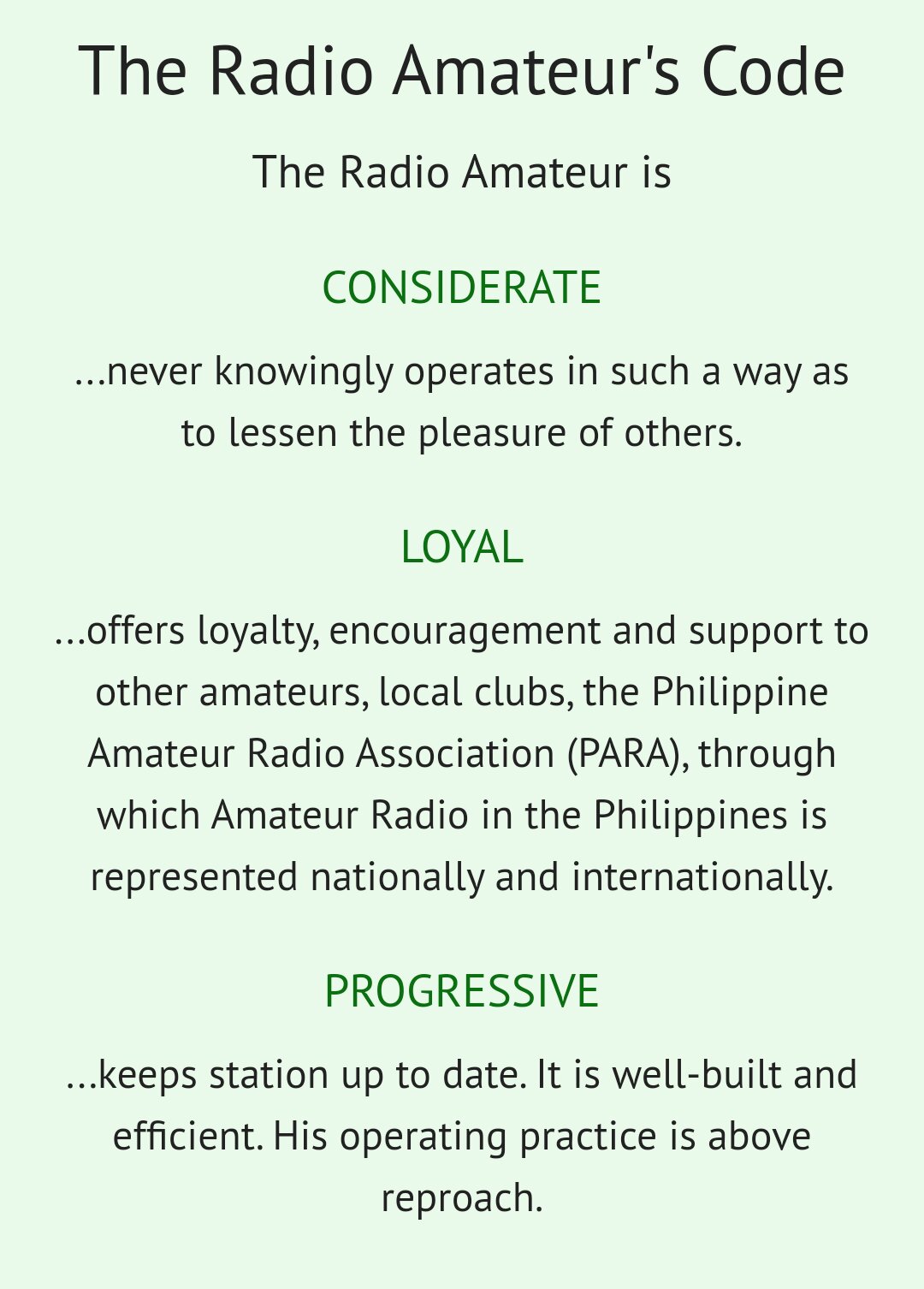
The Amateur’s Code

The Radio Amateur Is:

CONSIDERATE

never knowingly operating in such a way as to lessen the pleasure of others.


LOYAL

offering loyalty, encouragement and support to other amateurs, local clubs and the Philippine Amateur Radio Association, through which Amateur Radio in the Philippines is represented nationally and internationally.


PROGRESSIVE

with knowledge abreast of science, a well built and efficient station, and operation beyond reproach.


FRIENDLY

with slow and patient operation when requested, friendly advice and counsel to the beginner, kindly assistance, co-operation and consideration for the interests of others. These are the hallmarks of the amateur spirit.


BALANCED

Radio is an advocation, never interfering with duties owed to family, job, school or community.


PATRIOTIC

with station and skill always ready for service to country and community.

– adapted from the original Amateur’s Code, written by Paul M. Segal, W9EEA, in 1928

Philippine Amateur Radio Callsigns

Callsign of Amateur License in the Philippines.

DX1PAR

DX- prefix, 1 – amateur district/region, PAR – suffix

The standard format for Philippine callsigns is 2×3 – where 2 stands for the prefix letters (4D-4I or DU-DZ), and 3 stands for the suffix letters, both of which are assigned and regulated by the National Telecommunications Commission. A suffix can have as much as three (3) characters, and as little as one (1).

Prefixes

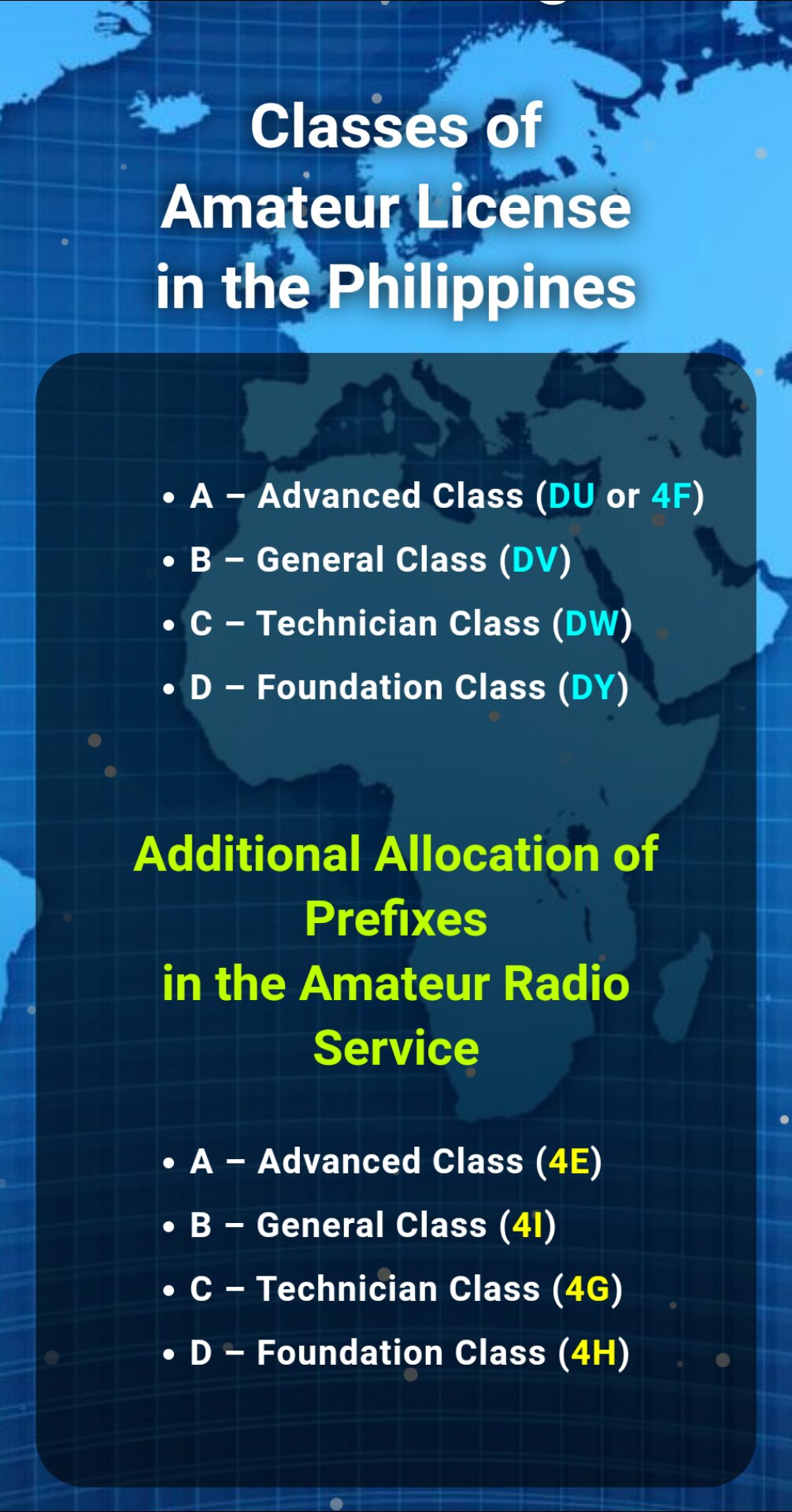
The NTC assigns prefixes depending on the privileges of the amateur license or for special events:

  • Class A – Advanced Class (DU or 4F)
  • Class B – General Class (DV)
  • Class C – Technician Class (DW)
  • Class D – Foundation Class (DY)

Additional Allocation of Prefixes in the Amateur Radio Service

  • Class A – Advanced Class (4E)
  • Class B – General Class (4I)
  • Class C – Technician Class (4G)
  • Class D – Foundation Class (4H)

Copyright

Philippines Amateur Radio Association Inc.

2021 Philippine AllStarLink System | Layout by DV8AWC

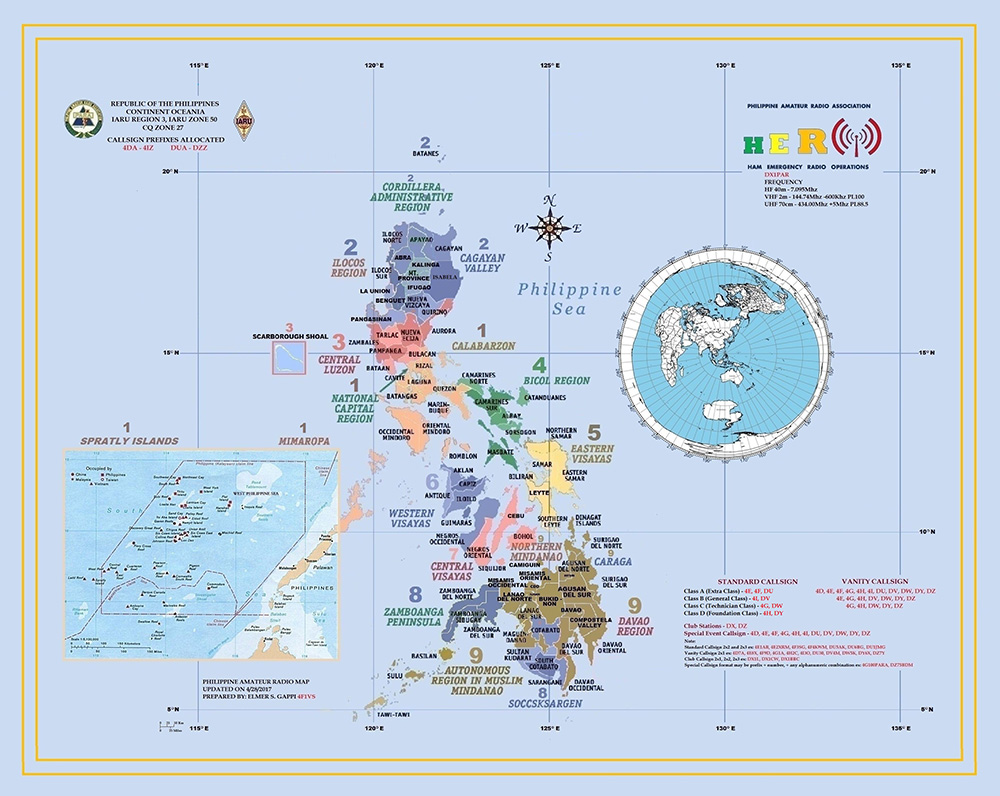
Philippines Amateur Radio District

District 1 – NCR

Metro Manila

  • Manila
  • Las Piñas
  • Makati
  • Muntinlupa
  • Parañaque
  • Pasay
  • Pateros
  • Taguig
  • Mandaluyong
  • Marikina
  • Pasig
  • Quezon City
  • San Juan City
  • Kalookan
  • Malabon
  • Navotas
  • Valenzuela

District 2

Ilocos Region (Region 1)

  • Ilocos Norte
  • Ilocos Sur
  • La Union
  • Pangasinan

Cagayan Valley (Region II)

  • Batanes
  • Cagayan
  • Isabela
  • Nueva Vizcaya
  • Quirino

Cordillera Administrative Region (CAR)

  • Abra
  • Apayao
  • Benguet
  • Ifugao
  • Kalinga
  • Mountain Province
  • Bontoc

District 3

Central Luzon (Region III)

  • Aurora
  • Bataan
  • Bulacan
  • Nueva Ecija
  • Pampanga
  • Tarlac
  • Zambales

District 4

Bicol Region (Region V)

  • Albay
  • Camarines Sur
  • Camarines Norte
  • Catanduanes
  • Masbate
  • Sorsogon

District 5

Eastern Visayas (Region VIII)

  • Biliran
  • Eastern Samar
  • Leyte
  • Northern Samar
  • Southern Leyte

District6

Western Visayas (Region VI)

  • Aklan
  • Antique
  • Capiz
  • Guimaras
  • Iloilo
  • Negros Occidental

District 7

Central Visayas (Region VII)

  • Bohol
  • Cebu
  • Negros Oriental, Siquijor

District 8

Zamboanga Peninsula (Region IX)

  • Zamboanga del Norte
  • Zamboanga del Sur
  • Zamboanga
  • Sibugay

Soccsksargen (Region XII)

  • North Cotabato
  • Cotabato City
  • Sarangani
  • South Cotabato
  • Sultan Kudarat

ARMM

  • Basilan
  • Lanao del Sur
  • Maguindanao
  • ShariffKabunsuan
  • Sulu
  • Tawi-Tawi

District 9

Northern Mindanao (Region X)

  • Bukidnon
  • Camiguin, Lanao del Norte
  • Misamis Occidental
  • Misamis Oriental

Davao Region (XI)

  • Compostela Valley
  • Davao del Norte
  • Davao del Sur
  • Davao Oriental

CARAGA Region (XIII)

  • Agusan del Norte
  • Agusan del Sur
  • Dinagat Islands
  • Surigao del Norte
  • Surigao del Sur
  • Butuan

The RST Report

The R-S-T system is used by amateur radio operatorsshortwave listeners, and other radio hobbyists to exchange information about the quality of a radio signal being received. The code is a three digit number, with one digit each for conveying an assessment of the signal’s readability, strength, and tone.[1][2] The code was developed in 1934 by Amateur radio operator Arthur W. Braaten, W2BSR,[3][4][5][6] and was similar to that codified in the ITU Radio Regulations, Cairo, 1938.[7]

Readability

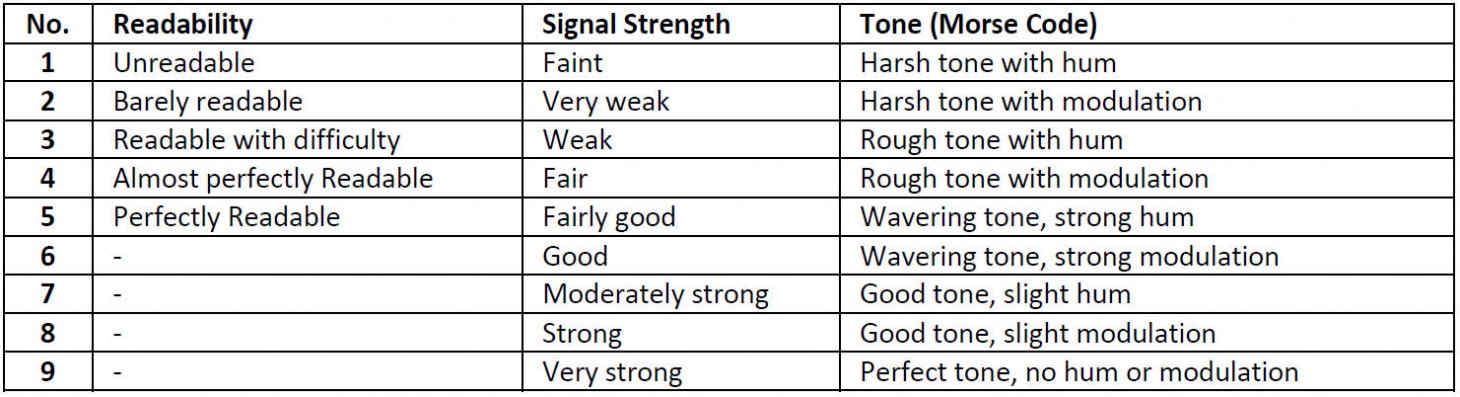
he R stands for “Readability”. Readability is a qualitative assessment of how easy or difficult it is to correctly copy the information being sent during the transmission. In a Morse codetelegraphy transmission, readability refers to how easy or difficult it is to distinguish each of the characters in the text of the message being sent; in a voice transmission, readability refers to how easy or difficult it is for each spoken word to be understood correctly. Readability is measured on a scale of 1 to 5.[8]

  1. Unreadable
  2. Barely readable, occasional words distinguishable
  3. Readable with considerable difficulty
  4. Readable with practically no difficulty
  5. Perfectly readable

Strength

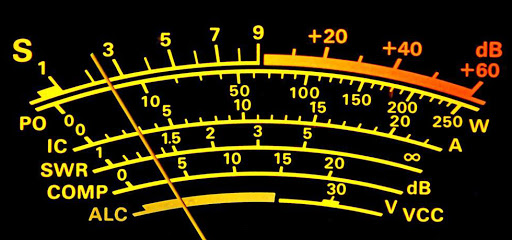
The S stands for “Strength”. Strength is an assessment of how powerful the received signal is at the receiving location. Although an accurate signal strength meter can determine a quantitative value for signal strength, in practice this portion of the RST code is a qualitative assessment, often made based on the S meter of the radio receiver at the location of signal reception. “Strength” is measured on a scale of 1 to 9.[8]

  1. Faint—signals barely perceptible
  2. Very weak signals
  3. Weak signals
  4. Fair signals
  5. Fairly good signals
  6. Good signals
  7. Moderately strong signals
  8. Strong signals
  9. Extremely strong signals

For a quantitative assessment, quality HF receivers are calibrated so that S9 on the S-meter corresponds to a signal of 50 μV at the antenna standard terminal impedance 50 ohms.[9] One “S” difference should correspond to 6 dB at signal strength (2x voltage = 4x power). On VHF and UHF receivers used for weak signal communications, S9 often corresponds to 5 μV at the antenna terminal 50 ohms. Amateur radio (ham) operators may also use a signal strength of “20 to 60 over 9”, or “+20 to +60 over 9.” This is in reference to a signal that exceeds S9 on a signal meter on a HF receiver.

Tone

The T stands for “Tone” and is measured on a scale of 1 to 9. Tone only pertains to Morse code and other digital transmission modes and is therefore omitted during voice operations. With modern technology, imperfections in the quality of transmitters’ digital modulation severe enough to be detected by human ears are rare.[8]

Value1936 definitionmodern definition
1Extremely rough hissing noteSixty cycle a.c or less, very rough and broad
2Very rough a.c. note, no trace of musicalityVery rough a.c., very harsh and broad
3Rough, low-pitched a.c. note, slightly musicalRough a.c. tone, rectified but not filtered
4Rather rough a.c. note, moderately musicalRough note, some trace of filtering
5Musically modulated noteFiltered rectified a.c. but strongly ripple-modulated
6Modulated note, slight trace of whistleFiltered tone, definite trace of ripple modulation
7Near d.c. note, smooth rippleNear pure tone, trace of ripple modulation
8Good d.c. note, just a trace of rippleNear perfect tone, slight trace of modulation
9Purest d.c. notePerfect tone, no trace of ripple or modulation of any kind
If there are other notable tonal qualities add one or more of the letters AXlisted below, after the number.

The RST report (Radio, Signal, Tone) [12] is manly used by amateur radio operators and describes the quality of a radio communication with a two or three digit number.

The first digit describes the intelligibility of the signal, the second the strength of the signal and if it’s a CW transmission, the third digit describes the quality of the tone.

The RST report is just a subjective evaluation of the received signal and it’s not supposed to be a precise measure. In practice the majority of the reports are 59 (or 599) as a sort of courtesy to the corresponding ham, regardless of the quality of the QSO.

RadioStrengthTone (CW only)
1 Not intelligible.1 Extremely low signals.1 Only noise.
2 Just intelligible: some words only.2 Very low signals.2 Very noisy AC tone.
3 Bad intelligibility.3 Low signals.3 Low AC tone.
4 Good intelligibility.4 Poor signals.4 AC tone.
5 Very good intelligibility.5 Medium signals.5 Modulated tone, whistle in the background.
 N/A6 Good signals.6 Modulated tone, some noise.
 N/A7 Strong signals.7 DC tone, little noise.
 N/A8 Very strong signals.8 Good DC tone, very little noise.
 N/a9 Extremely strong signals.9 Pure DC tone.

References

  1.  “Quick Reference Operating Aids (The RST System)”.
  2. ^ “Ham Radio “RST” Signal Reporting System for CW/Phone Operation”. University of Buffalo. Retrieved 24 September 2017.
  3. ^ “The Radio Amateur’s Handbook” (PDF). p. 363. Retrieved 4 July 2015.
  4. ^ “The RST Standard of Reporting”. Retrieved 4 July 2015.
  5. ^ Andrea, Steve. “Can You Read Me Now?” (PDF). ARRL. Retrieved 4 July 2015.
  6. ^ Arthur M. Braaten, W2BSR. “A New Standard System of Reporting Signals” (PDF). ARRL. p. 18. Retrieved 4 July 2015.
  7. ^ Alcorn, John (October 2002). “Radiotelegraph and Radiotelephone Codes, Prowords and Abbreviations for the Summerland Amateur Radio Club” (PDF). Retrieved February 5, 2020.
  8. Jump up to:a b c The beginner’s handbook of amateur radio by Clay Laster, Page 379, McGraw-Hill Professional, 2000, ISBN 0-07-136187-1ISBN 978-0-07-136187-3
  9. ^ “S9 Signal reference”.
  10. ^ VHF Managers’ Handbook. Region 1. International Amateur Radio Union. 2013.
  11. ^ http://www.radioing.com/hamstart/rst.html Ham Radio RST Signal Reporting System for CW Operation, by Charlie Bautsch, W5AM
  12. ^ “CW”QSL.net.
  13. ^ http://ac6v.com/morseaids.php#AB MORSE CODE, INTERNATIONAL EXTENSIONS AND ABBREVIATED NUMBERS
  14. ^ “Codes and Alphabets”amateur-radio-wiki.net. bottom of § RST code.
  15. ^ “R-S-M-Q, A Standard Method of Reporting for Telephony”(PDF).

The SINPO (or SINFO) Report

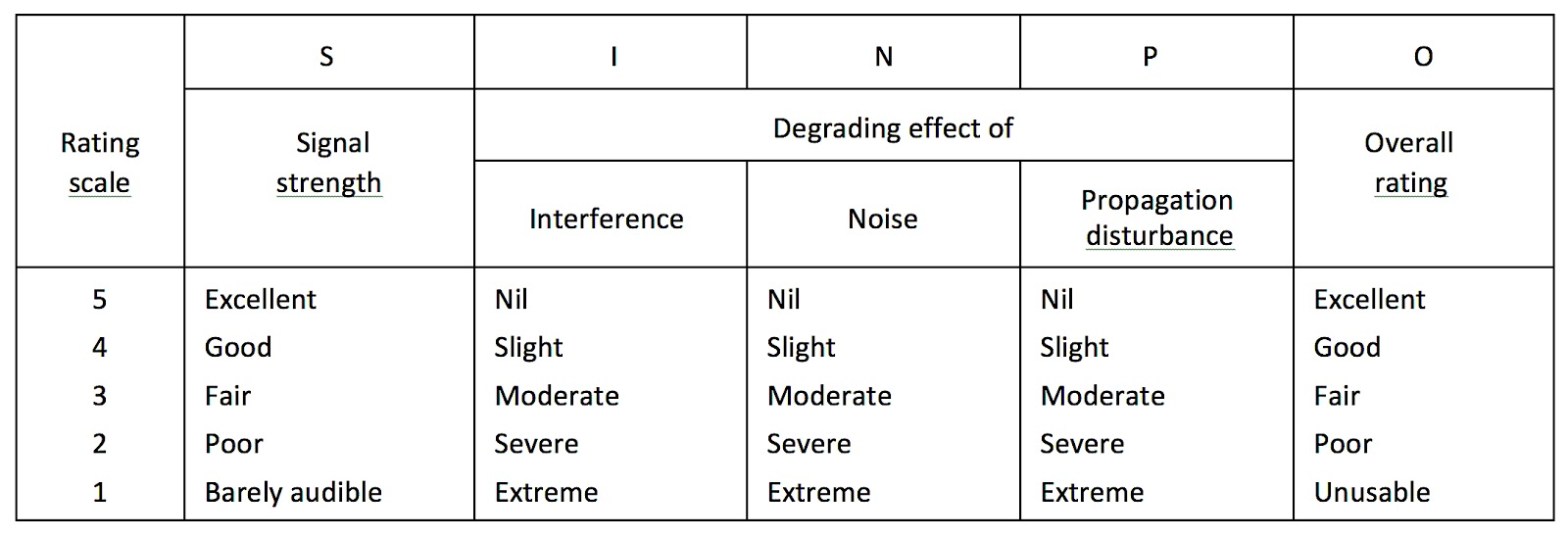
SINPO, an acronym for Signal, Interference, Noise, Propagation, and Overall, is a Signal Reporting Code used to describe the quality of broadcast and radiotelegraph transmissions. SINPFEMO, an acronym for Signal, Interference, Noise, Propagation, frequency of Fading, dEpth, Modulation, and Overall is used to describe the quality of radiotelephony transmissions. SINPFEMO code consists of the SINPO code plus the addition of three letters to describe additional features of radiotelephony transmissions. These codes are defined by Recommendation ITU-R Sm.1135, SINPO and SINPFEMO codes.[1]

SINPO code is most frequently used in reception reports written by shortwave listeners. Each letter of the code stands for a specific factor of the signal, and each item is graded on a 1 to 5 scale (where 1 stands for nearly undetectable/severe/unusable and 5 for excellent/nil/extremely strong).

The code originated with the CCIR (a predecessor to the ITU-R) in 1951, and was widely used by BBC shortwave listeners to submit signal reports, with many going so far as to mail audio recordings to the BBC’s offices.[2]

SINPO and SINPFEMO are the official signal reporting codes for international civil aviation [3] and ITU-R.[1]

The use of the SINPO code can be subjective and may vary from person to person. Not all shortwave listeners are conversant with the SINPO code and prefer using plain language instead.

SINPO code explained

S (Signal strength)The relative strength of the transmission.
I (Interference)Interference from other stations on the same or adjacent frequencies.
N (Noise)The amount of atmospheric or man-made noise.
P (Propagation)Whether the signal is steady or fades from time to time.
O (Overall merit)An overall score for the listening experience under these conditions.

RatingSINPO
ScaleSignal strengthInterferenceNoisePropagation DisturbanceOverall rating
5ExcellentNilNilNilExcellent
4GoodSlightSlightSlightGood
3FairModerateModerateModerateFair
2PoorSevereSevereSeverePoor
1Barely audibleExtremeExtremeExtremeUnusable

SINPFEMO code

An extension of SINPO code, for use in radiotelephony (voice over radio) communications, SINPFEMO is an acronym for Signal, Interference, Noise, Propagation, frequency of Fading, depth, Modulation, and Overall.

 SINPFEMO
Rating ScaleSignal strengthInterferenceNoisePropagation disturbanceFrequency of fadingQualityDepthOverall rating
5ExcellentNilNilNilNilExcellentMaximumExcellent
4GoodSlightSlightSlightSlowGoodGoodGood
3FairModerateModerateModerateModerateFairFairFair
2PoorSevereSevereSevereFastPoorPoor or NilPoor
1Barely audibleExtremeExtremeExtremeVery fastVery PoorContinuously over-modulatedUnusable

References[edit]

  1. Jump up to:a b “ITU-R Sm.1135, SINPO and SINPFEMO codes” (PDF).
  2. ^ “BBC Engineering Division Monnograph, Number 43: September 1962” (PDF).
  3. ^ “Procedures for Air Navigation Services: ICAO Abbreviations and Codes” (PDF). Retrieved 27 April 2015.
  4. ^ “Reception Reports: Reporting Code – Writing Useful Reception Reports”. Archived from the original on January 7, 2009. Retrieved 27 April 2015.
  5. ^ Berg, Jerome. Early Shortwave Stations.

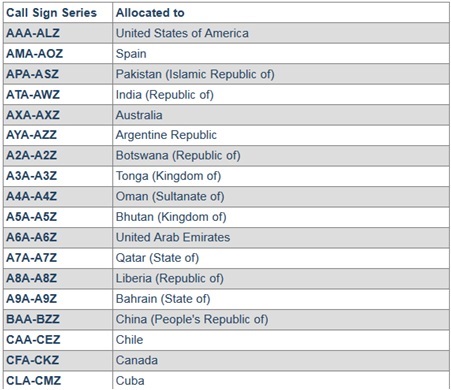
ITU Table of Allocation of International Call Sign Series

Prefix assignments by the International Telecommunications Union (ITU).

Call Sign SeriesAllocated to
T6A-T6ZAfghanistan (Islamic State of)
YAA-YAZAfghanistan (Islamic State of)
ZAA-ZAZAlbania (Republic of)
7RA-7RZAlgeria (People’s Democratic Republic of)
7TA-7YZAlgeria (People’s Democratic Republic of)
C3A-C3ZAndorra (Principality of)
D2A-D3ZAngola (Republic of)
V2A-V2ZAntigua and Barbuda
AYA-AZZArgentine Republic
LOA-LWZArgentine Republic
L2A-L9ZArgentine Republic
EKA-EKZArmenia (Republic of)
AXA-AXZAustralia
VHA-VNZAustralia
VZA-VZZAustralia
OEA-OEZAustria
4JA-4KZAzerbaijani Republic
C6A-C6ZBahamas (Commonwealth of the)
A9A-A9ZBahrain (State of)
S2A-S3ZBangladesh (People’s Republic of)
8PA-8PZBarbados
EUA-EWZBelarus (Republic of)
ONA-OTZBelgium
V3A-V3ZBelize
TYA-TYZBenin (Republic of)
A5A-A5ZBhutan (Kingdom of)
CPA-CPZBolivia (Republic of)
E7A-E7ZBosnia and Herzegovina (Republic of)        (WRC-07)
A2A-A2ZBotswana (Republic of)
8OA-8OZBotswana (Republic of)
PPA-PYZBrazil (Federative Republic of)
ZVA-ZZZBrazil (Federative Republic of)
V8A-V8ZBrunei Darussalam
LZA-LZZBulgaria (Republic of)
XTA-XTZBurkina Faso
9UA-9UZBurundi (Republic of)
XUA-XUZCambodia (Kingdom of)
TJA-TJZCameroon (Republic of)
CFA-CKZCanada
CYA-CZZCanada
VAA-VGZCanada
VOA-VOZCanada
VXA-VYZCanada
XJA-XOZCanada
D4A-D4ZCape Verde (Republic of)
TLA-TLZCentral African Republic
TTA-TTZChad (Republic of)
CAA-CEZChile
XQA-XRZChile
3GA-3GZChile
BAA-BZZChina (People’s Republic of)
XSA-XSZChina (People’s Republic of)
3HA-3UZChina (People’s Republic of)
VRA-VRZChina (People’s Republic of) – Hong Kong
XXA-XXZChina (People’s Republic of) – Macao        (WRC-07)
HJA-HKZColombia (Republic of)
5JA-5KZColombia (Republic of)
D6A-D6ZComoros (Islamic Federal Republic of the)
TNA-TNZCongo (Republic of the)
TEA-TEZCosta Rica
TIA-TIZCosta Rica
TUA-TUZCôte d’Ivoire (Republic of)
9AA-9AZCroatia (Republic of)
CLA-CMZCuba
COA-COZCuba
T4A-T4ZCuba
C4A-C4ZCyprus (Republic of)
H2A-H2ZCyprus (Republic of)
P3A-P3ZCyprus (Republic of)
5BA-5BZCyprus (Republic of)
OKA-OLZCzech Republic
HMA-HMZDemocratic People’s Republic of Korea
P5A-P9ZDemocratic People’s Republic of Korea
9OA-9TZDemocratic Republic of the Congo
4WA-4WZDemocratic Republic of Timor-Leste   (WRC-03)
OUA-OZZDenmark
XPA-XPZDenmark
5PA-5QZDenmark
J2A-J2ZDjibouti (Republic of)
J7A-J7ZDominica (Commonwealth of)
HIA-HIZDominican Republic
HCA-HDZEcuador
SSA-SSMEgypt (Arab Republic of)
SUA-SUZEgypt (Arab Republic of)
6AA-6BZEgypt (Arab Republic of)
HUA-HUZEl Salvador (Republic of)
YSA-YSZEl Salvador (Republic of)
3CA-3CZEquatorial Guinea (Republic of)
E3A-E3ZEritrea
ESA-ESZEstonia (Republic of)
ETA-ETZEthiopia (Federal Democratic Republic of)
9EA-9FZEthiopia (Federal Democratic Republic of)
3DN-3DZFiji (Republic of)
OFA-OJZFinland
FAA-FZZFrance
HWA-HYZFrance
THA-THZFrance
TKA-TKZFrance
TMA-TMZFrance
TOA-TQZFrance
TVA-TXZFrance
TRA-TRZGabonese Republic
C5A-C5ZGambia (Republic of the)
4LA-4LZGeorgia (Republic of)
DAA-DRZGermany (Federal Republic of)
Y2A-Y9ZGermany (Federal Republic of)
9GA-9GZGhana
J4A-J4ZGreece
SVA-SZZGreece
J3A-J3ZGrenada
TDA-TDZGuatemala (Republic of)
TGA-TGZGuatemala (Republic of)
3XA-3XZGuinea (Republic of)
J5A-J5ZGuinea-Bissau (Republic of)
8RA-8RZGuyana
HHA-HHZHaiti (Republic of)
4VA-4VZHaiti (Republic of)
HQA-HRZHonduras (Republic of)
HAA-HAZHungary (Republic of)
HGA-HGZHungary (Republic of)
TFA-TFZIceland
ATA-AWZIndia (Republic of)
VTA-VWZIndia (Republic of)
8TA-8YZIndia (Republic of)
JZA-JZZIndonesia (Republic of)
PKA-POZIndonesia (Republic of)
YBA-YHZIndonesia (Republic of)
7AA-7IZIndonesia (Republic of)
8AA-8IZIndonesia (Republic of)
* 4YA-4YZInternational Civil Aviation Organization
EPA-EQZIran (Islamic Republic of)
9BA-9DZIran (Islamic Republic of)
HNA-HNZIraq (Republic of)
YIA-YIZIraq (Republic of)
EIA-EJZIreland
4XA-4XZIsrael (State of)
4ZA-4ZZIsrael (State of)
IAA-IZZItaly
6YA-6YZJamaica
JAA-JSZJapan
7JA-7NZJapan
8JA-8NZJapan
JYA-JYZJordan (Hashemite Kingdom of)
UNA-UQZKazakhstan (Republic of)
5YA-5ZZKenya (Republic of)
3DA-3DMKingdom of Eswatini
T3A-T3ZKiribati (Republic of)
DSA-DTZKorea (Republic of)
D7A-D9ZKorea (Republic of)
HLA-HLZKorea (Republic of)
6KA-6NZKorea (Republic of)
Z6A-Z6ZKosovo (Republic of)
9KA-9KZKuwait (State of)
EXA-EXZKyrgyz Republic
XWA-XWZLao People’s Democratic Republic
YLA-YLZLatvia (Republic of)
ODA-ODZLebanon
7PA-7PZLesotho (Kingdom of)
A8A-A8ZLiberia (Republic of)
D5A-D5ZLiberia (Republic of)
ELA-ELZLiberia (Republic of)
5LA-5MZLiberia (Republic of)
6ZA-6ZZLiberia (Republic of)
5AA-5AZLibya (Socialist People’s Libyan Arab Jamahiriya)
LYA-LYZLithuania (Republic of)
LXA-LXZLuxembourg
5RA-5SZMadagascar (Republic of)
6XA-6XZMadagascar (Republic of)
7QA-7QZMalawi
9MA-9MZMalaysia
9WA-9WZMalaysia
8QA-8QZMaldives (Republic of)
TZA-TZZMali (Republic of)
9HA-9HZMalta
V7A-V7ZMarshall Islands (Republic of the)
5TA-5TZMauritania (Islamic Republic of)
3BA-3BZMauritius (Republic of)
XAA-XIZMexico
4AA-4CZMexico
6DA-6JZMexico
V6A-V6ZMicronesia (Federated States of)
ERA-ERZMoldova (Republic of)
3AA-3AZMonaco (Principality of)
JTA-JVZMongolia
4OA-4OZMontenegro (Republic of)                   (WRC-07)
CNA-CNZMorocco (Kingdom of)
5CA-5GZMorocco (Kingdom of)
C8A-C9ZMozambique (Republic of)
XYA-XZZMyanmar (Union of)
V5A-V5ZNamibia (Republic of)
C2A-C2ZNauru (Republic of)
9NA-9NZNepal
PAA-PIZNetherlands (Kingdom of the)
P4A-P4ZNetherlands (Kingdom of the) – Aruba
PJA-PJZNetherlands (Kingdom of the) – Netherlands Caribbean
ZKA-ZMZNew Zealand
E5A-E5ZNew Zealand – Cook Islands                     (WRC-07)
E6A-E6ZNew Zealand – Niue
HTA-HTZNicaragua
H6A-H7ZNicaragua
YNA-YNZNicaragua
5UA-5UZNiger (Republic of the)
5NA-5OZNigeria (Federal Republic of)
Z3A-Z3ZNorth Macedonia (Republic of)
JWA-JXZNorway
LAA-LNZNorway
3YA-3YZNorway
A4A-A4ZOman (Sultanate of)
APA-ASZPakistan (Islamic Republic of)
6PA-6SZPakistan (Islamic Republic of)
T8A-T8ZPalau (Republic of)
** E4A-E4ZPalestinian Authority
HOA-HPZPanama (Republic of)
H3A-H3ZPanama (Republic of)
H8A-H9ZPanama (Republic of)
3EA-3FZPanama (Republic of)
P2A-P2ZPapua New Guinea
ZPA-ZPZParaguay (Republic of)
OAA-OCZPeru
4TA-4TZPeru
DUA-DZZPhilippines (Republic of the)
4DA-4IZPhilippines (Republic of the)
HFA-HFZPoland (Republic of)
SNA-SRZPoland (Republic of)
3ZA-3ZZPoland (Republic of)
CQA-CUZPortugal
A7A-A7ZQatar (State of)
YOA-YRZRomania
RAA-RZZRussian Federation
UAA-UIZRussian Federation
9XA-9XZRwandese Republic
V4A-V4ZSaint Kitts and Nevis
J6A-J6ZSaint Lucia
J8A-J8ZSaint Vincent and the Grenadines
5WA-5WZSamoa (Independent State of)
T7A-T7ZSan Marino (Republic of)
S9A-S9ZSao Tome and Principe (Democratic Republic of)
HZA-HZZSaudi Arabia (Kingdom of)
7ZA-7ZZSaudi Arabia (Kingdom of)
8ZA-8ZZSaudi Arabia (Kingdom of)
6VA-6WZSenegal (Republic of)
YTA-YUZSerbia (Republic of)                                 (WRC-07)
S7A-S7ZSeychelles (Republic of)
9LA-9LZSierra Leone
S6A-S6ZSingapore (Republic of)
9VA-9VZSingapore (Republic of)
OMA-OMZSlovak Republic
S5A-S5ZSlovenia (Republic of)
H4A-H4ZSolomon Islands
T5A-T5ZSomali Democratic Republic
6OA-6OZSomali Democratic Republic
S8A-S8ZSouth Africa (Republic of)
ZRA-ZUZSouth Africa (Republic of)
Z8A-Z8ZSouth Sudan (Republic of)
AMA-AOZSpain
EAA-EHZSpain
4PA-4SZSri Lanka (Democratic Socialist Republic of)
SSN-STZSudan (Republic of the)
6TA-6UZSudan (Republic of the)
PZA-PZZSuriname (Republic of)
SAA-SMZSweden
7SA-7SZSweden
8SA-8SZSweden
HBA-HBZSwitzerland (Confederation of)
HEA-HEZSwitzerland (Confederation of)
YKA-YKZSyrian Arab Republic
6CA-6CZSyrian Arab Republic
EYA-EYZTajikistan (Republic of)
5HA-5IZTanzania (United Republic of)
E2A-E2ZThailand
HSA-HSZThailand
5VA-5VZTogolese Republic
A3A-A3ZTonga (Kingdom of)
9YA-9ZZTrinidad and Tobago
TSA-TSZTunisia
3VA-3VZTunisia
TAA-TCZTurkey
YMA-YMZTurkey
EZA-EZZTurkmenistan
T2A-T2ZTuvalu
5XA-5XZUganda (Republic of)
EMA-EOZUkraine
URA-UZZUkraine
A6A-A6ZUnited Arab Emirates
GAA-GZZUnited Kingdom of Great Britain and Northern Ireland
MAA-MZZUnited Kingdom of Great Britain and Northern Ireland
VPA-VQZUnited Kingdom of Great Britain and Northern Ireland
VSA-VSZUnited Kingdom of Great Britain and Northern Ireland
ZBA-ZJZUnited Kingdom of Great Britain and Northern Ireland
ZNA-ZOZUnited Kingdom of Great Britain and Northern Ireland
ZQA-ZQZUnited Kingdom of Great Britain and Northern Ireland
2AA-2ZZUnited Kingdom of Great Britain and Northern Ireland
* 4UA-4UZUnited Nations
AAA-ALZUnited States of America
KAA-KZZUnited States of America
NAA-NZZUnited States of America
WAA-WZZUnited States of America
CVA-CXZUruguay (Eastern Republic of)
UJA-UMZUzbekistan (Republic of)
YJA-YJZVanuatu (Republic of)
HVA-HVZVatican City State
YVA-YYZVenezuela (Republic of)
4MA-4MZVenezuela (Republic of)
XVA-XVZViet Nam (Socialist Republic of)
3WA-3WZViet Nam (Socialist Republic of)
* C7A-C7ZWorld Meteorological Organization
7OA-7OZYemen (Republic of)
9IA-9JZZambia (Republic of)
Z2A-Z2ZZimbabwe (Republic of)

* Series allocated to an international organization.

** In response to Resolution 99 (Minneapolis, 1998) of the Plenipotentiary Conference (WRC-2000)

http://www.arrl.org/international-call-sign-series

Modulation classification

This page contains an abstract of the modulation classification according to the ITU standard.

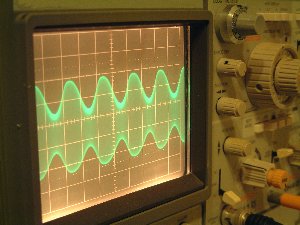
The classification is done with a three-symbol code: the first symbol (which is usually a letter) describes the modulation of the main carrier, the second symbol (which is usually a digit) describes the signal that modulates the main carrier and the third symbol (which is usually a letter) describes the transmitted information.

Extra modulations only used for a short amount of time (for example for sending the call-ID) are often not taken into account if the main bandwidth is not increased.

First symbol: modulation of the main carrierSecond symbol: type of signal(s) modulating the main carrierThird symbol: type of transmitted information
N Unmodulated carrier
Amplitude modulation
A Double sideband amplitude modulated carrier.
H Single sideband, full carrier
R Single sideband, reduced (or variable) carrier.
J Single sideband, suppressed carrier
B Independent sidebands
C Vestigial sideband
Angular modulation
F Frequency modulation
G Phase modulation
Pulse modulation
D Amplitude and phase modulation
P Unmodulated pulse modulation
K Pulse amplitude modulation
L Pulse width/length modulation
M Pulse position/phase modulation
Q Phase modulation during pulses
V Other pulse modulations
Other modulations
W Other combinations of amplitude, phase and pulse modulation
X Other modulations
0 No modulation signal
1 One digital channel, no subcarrier
2 One digital channel, with subcarrier
3 One analog channel
7 Two or more digital channels
8 Two or more analog channels
9 Compound system with one or more digital channels and one or more analog channels
X Other signals
N No information
A Telegraph – manual decoding
B Telegraph – automatic decoding
C Fax
D Data transmission, remote control
E Telephone, audio
F Television, video
W Combination of the above
X Other information

Examples:

N0NUnmodulated test signal:
A1AAmateur radio CW transmission:
A3EAM broadcast station:
C3FTerrestrial TV (video only):
J3EAmateur radio SSB transmission:
F3EFM broadcast station:
F3FAnalog satellite TV (video only):

Bibliography and further reading

[1]OFCOM – Office fédéral de la communication. Prescriptions concernant les radioamateurs. Section concessions de radiocommunication, Rue de l’Avenir 44, CH-2503 Bienne, 2001, Section 53 et appendice 2.

Ham radio abbreviations

Here is a non exhaustive list of ham radio abbreviations, particularly used in CW QSOs.

ABBREVIATIONSMeaning
ABTAbout
AGNAgain
ANSAnswer
ANTAntenna
B4Before
BCBroadcast
BDBad
BKBack or break
BNBeen, being
BTWBy the way
BUROQSL bureau
CCorrect, yes
CBACallbook address
CFMConfirm
CLClosing station down
CLGCalling
CLRClear
CONDXConditions
CPICopy
CPYCopy
CQGeneral call for a QSO (contact)
CWContinuous waves (morse code)
DEFrom
DRDear
DWNDown
DXLong distance contact, rare station
ESAnd
FBFine business, very good
FERFor
GAGood afternoon or go ahead
GBGood bye
GDGood or Good day
GEGood evening
GMGood morning
GNGood night
GNDGround
GPGround-plane antenna
GUDGood
HAMAmateur radio operator
HILaughter on CW
HRHere or ham radio
HVHave
HW?How do you copy me? What about you?
KPlease transmit
KNOnly the station I am working should transmit
LIDPoor operator
LPLog-periodic antenna or long path
LSBLower sideband
LWLong-wire antenna
MGRQSL manager
MNIMany
MSGMessage
NILNothing heard or no copy
NRNear
NWNow or North-West
OMOld man (amateur radio operator)
OPOperator name
OPROperator, operate
PSEPlease
POPower output
PWRPower
RMessage received or correct
RCVReceive
RCVDReceived
RCVRReceiver
RIGEquipment
RPRTReport
RPTRepeat
RXReceiver
SIGSignal
SKThis is my last transmission (stop keying)
SKEDSchedule
SNSoon
SNWSnow
SPShort path
SRISorry
STNStation
SWLShort waves listener
TEMPTemperature
TESTContest
TFCTraffic
TILUntil
TKSThanks
TCVRTransceiver
TUThank you
TXTransmitter
TNXThanks
UYou
UFBUltra fine business (excellent)
URYour
USBUpper sideband
VERTVertical antenna
VYVery
WWatts
WKDWorked (connected)
WPMWords Per Minute
WRKWork
WXWeather
XCVRTransceiver
XMTRTransmitter
XTALCrystal
XYLWife
YLYoung Lady
73Best regards
88Love and kisses

Bibliography and further reading

[1]Nerio Neri I4NE. Radiotecnica per Radioamatori. C&C – Edizioni Radioelettroniche, 1994, Appendice 14.
[2]Carlo Amorati I4ALU. Manuale di radiotelegrafia. C&C – Edizioni Radioelettroniche, 1995, Tavola 1, p. 111.
[3]OFCOM – Office fédéral de la communication. Prescriptions concernant les radioamateurs. Section concessions de radiocommunication, Rue de l’Avenir 44, CH-2503 Bienne, 2001, Appendice 4.

S-meter and signal strength

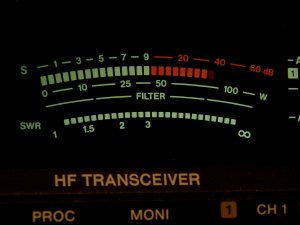
The S-meter is an instrument present on the majority of radio receivers that measures the strength of the signal that is being received, and uses a special unit: the S-point. S-points are often used for RST reports.

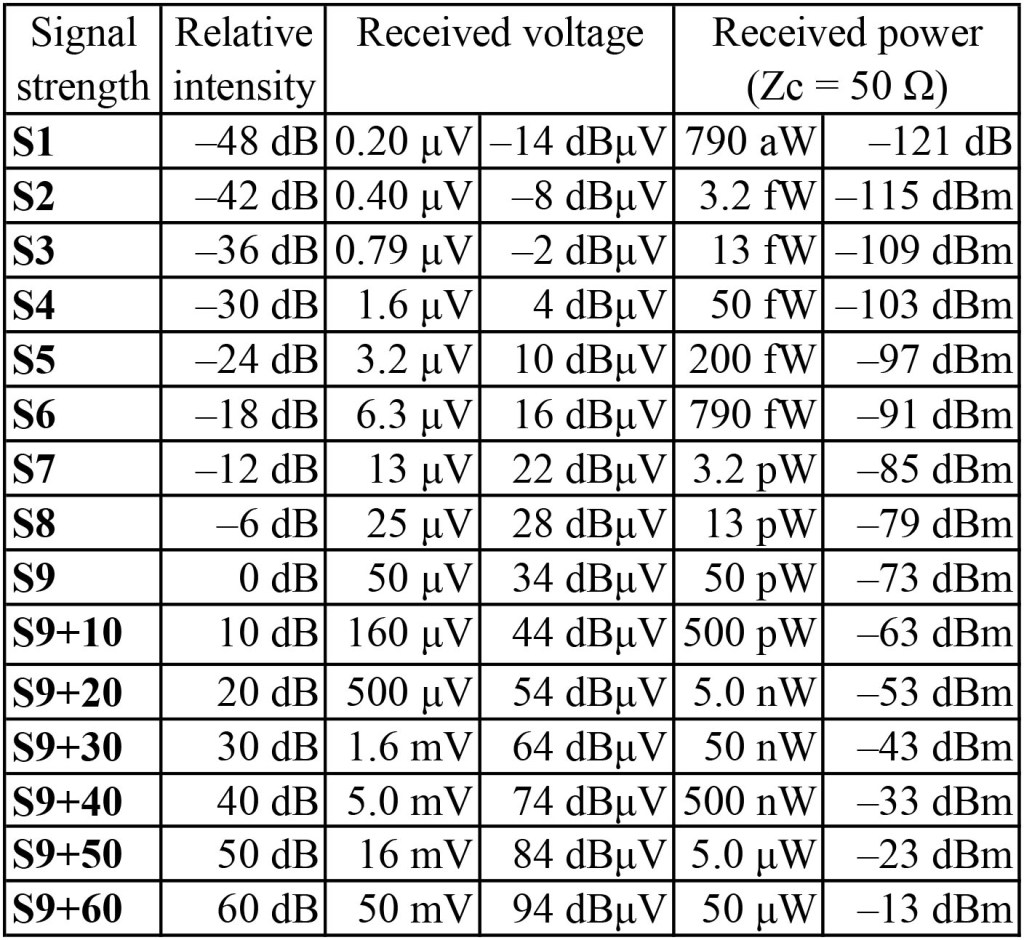
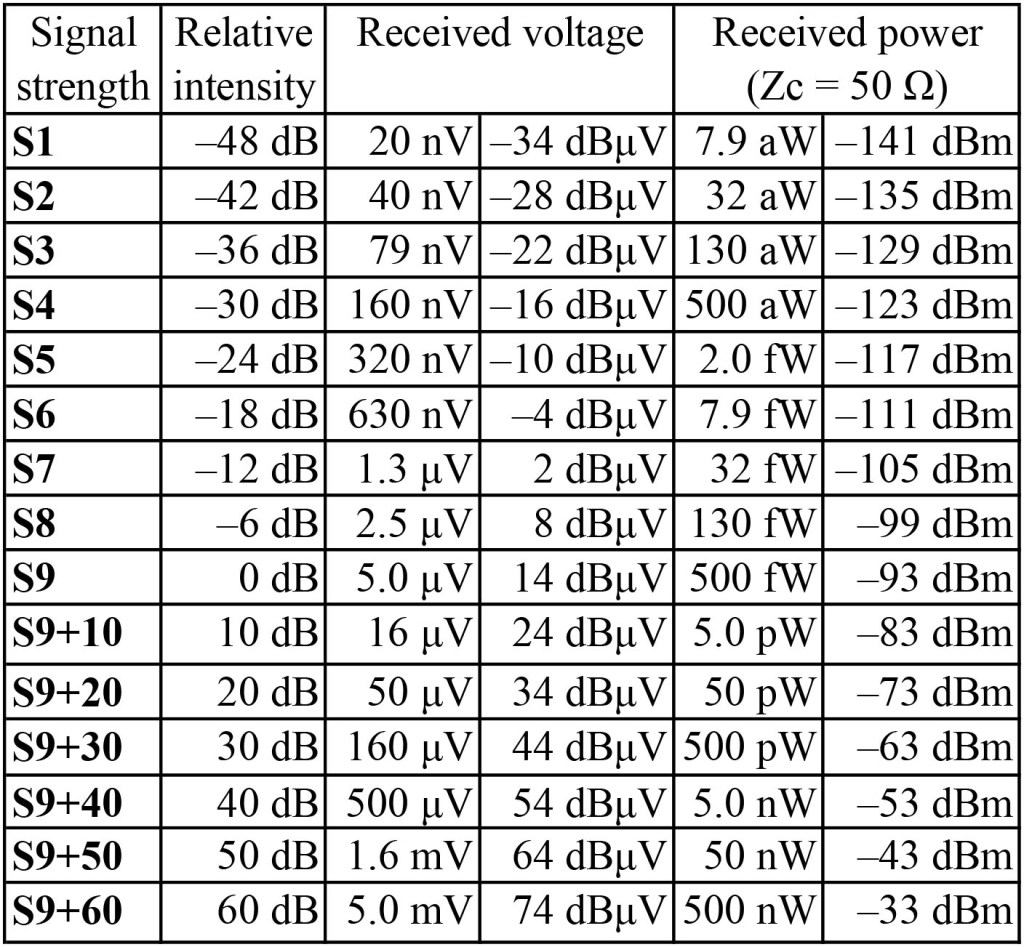
S-points go from S1 to S9 and each S-point is defined as a 6 dB change in signal strength. This means that each time the voltage is halved (–6 dB) the signal strength decreases by one point. S9 is already a very strong signal, but to describe larger signals, steps of 10 dB are used instead of 6 dB, noted “S9+20” meaning 20 dB above S9.

Today two reference values exist: for frequencies below 30 MHz, S9 is defined as a voltage of 50 μV over 50 Ω at the receiver antenna connector; for frequencies above 30 MHz, S9 is defined as a voltage of 5 μV over 50 Ω at the receiver antenna connector. This refers to an unmodulated carrier signal (N0N) that uses almost no bandwidth; in case of real signals using a given bandwidth, this definition may not be enough since a smaller receiver bandwidth allows a weaker minimum detectable signal, but S-points are still a good tool for comparing received signals.

S-points for frequencies below 30 MHz:

S-points for frequencies above 30 MHz:

Older receivers were calibrated using the old standard that defined S9 as a voltage of 100 μV instead of 50 μV over 50 Ω at the receiver antenna connector.

Usually S-meters in amateur radio equipment are not calibrated and are not very precise. S-meter readings may also vary from one band to another and it’s always interesting to check an S-meter with a precise generator and a step by step attenuator.

Bibliography and further reading

[1]Wolfgang Link, DL8FI. Metodi di misura per radioamatori. Franco Muzzio & C. editore, 1978, sezione 3.9.

Design a site like this with WordPress.com
Get started