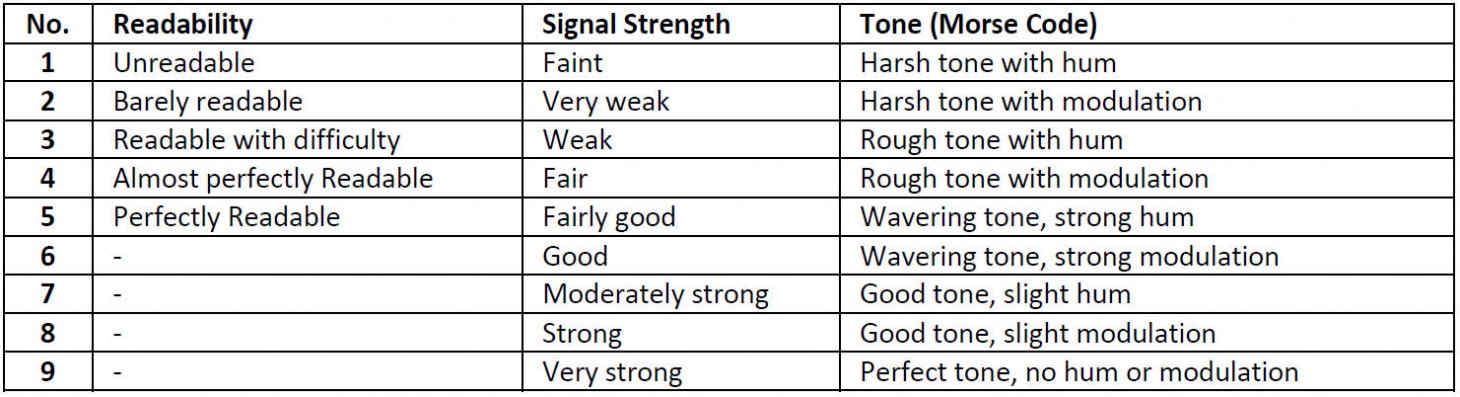
The R-S-T system is used by amateur radio operators, shortwave listeners, and other radio hobbyists to exchange information about the quality of a radio signal being received. The code is a three digit number, with one digit each for conveying an assessment of the signal’s readability, strength, and tone.[1][2] The code was developed in 1934 by Amateur radio operator Arthur W. Braaten, W2BSR,[3][4][5][6] and was similar to that codified in the ITU Radio Regulations, Cairo, 1938.[7]
Readability
he R stands for “Readability”. Readability is a qualitative assessment of how easy or difficult it is to correctly copy the information being sent during the transmission. In a Morse codetelegraphy transmission, readability refers to how easy or difficult it is to distinguish each of the characters in the text of the message being sent; in a voice transmission, readability refers to how easy or difficult it is for each spoken word to be understood correctly. Readability is measured on a scale of 1 to 5.[8]
- Unreadable
- Barely readable, occasional words distinguishable
- Readable with considerable difficulty
- Readable with practically no difficulty
- Perfectly readable
Strength
The S stands for “Strength”. Strength is an assessment of how powerful the received signal is at the receiving location. Although an accurate signal strength meter can determine a quantitative value for signal strength, in practice this portion of the RST code is a qualitative assessment, often made based on the S meter of the radio receiver at the location of signal reception. “Strength” is measured on a scale of 1 to 9.[8]
- Faint—signals barely perceptible
- Very weak signals
- Weak signals
- Fair signals
- Fairly good signals
- Good signals
- Moderately strong signals
- Strong signals
- Extremely strong signals
For a quantitative assessment, quality HF receivers are calibrated so that S9 on the S-meter corresponds to a signal of 50 μV at the antenna standard terminal impedance 50 ohms.[9] One “S” difference should correspond to 6 dB at signal strength (2x voltage = 4x power). On VHF and UHF receivers used for weak signal communications, S9 often corresponds to 5 μV at the antenna terminal 50 ohms. Amateur radio (ham) operators may also use a signal strength of “20 to 60 over 9”, or “+20 to +60 over 9.” This is in reference to a signal that exceeds S9 on a signal meter on a HF receiver.
Tone
The T stands for “Tone” and is measured on a scale of 1 to 9. Tone only pertains to Morse code and other digital transmission modes and is therefore omitted during voice operations. With modern technology, imperfections in the quality of transmitters’ digital modulation severe enough to be detected by human ears are rare.[8]
| Value | 1936 definition | modern definition |
| 1 | Extremely rough hissing note | Sixty cycle a.c or less, very rough and broad |
| 2 | Very rough a.c. note, no trace of musicality | Very rough a.c., very harsh and broad |
| 3 | Rough, low-pitched a.c. note, slightly musical | Rough a.c. tone, rectified but not filtered |
| 4 | Rather rough a.c. note, moderately musical | Rough note, some trace of filtering |
| 5 | Musically modulated note | Filtered rectified a.c. but strongly ripple-modulated |
| 6 | Modulated note, slight trace of whistle | Filtered tone, definite trace of ripple modulation |
| 7 | Near d.c. note, smooth ripple | Near pure tone, trace of ripple modulation |
| 8 | Good d.c. note, just a trace of ripple | Near perfect tone, slight trace of modulation |
| 9 | Purest d.c. note | Perfect tone, no trace of ripple or modulation of any kind |
The RST report (Radio, Signal, Tone) [1, 2] is manly used by amateur radio operators and describes the quality of a radio communication with a two or three digit number.
The first digit describes the intelligibility of the signal, the second the strength of the signal and if it’s a CW transmission, the third digit describes the quality of the tone.
The RST report is just a subjective evaluation of the received signal and it’s not supposed to be a precise measure. In practice the majority of the reports are 59 (or 599) as a sort of courtesy to the corresponding ham, regardless of the quality of the QSO.
| Radio | Strength | Tone (CW only) |
| 1 Not intelligible. | 1 Extremely low signals. | 1 Only noise. |
| 2 Just intelligible: some words only. | 2 Very low signals. | 2 Very noisy AC tone. |
| 3 Bad intelligibility. | 3 Low signals. | 3 Low AC tone. |
| 4 Good intelligibility. | 4 Poor signals. | 4 AC tone. |
| 5 Very good intelligibility. | 5 Medium signals. | 5 Modulated tone, whistle in the background. |
| N/A | 6 Good signals. | 6 Modulated tone, some noise. |
| N/A | 7 Strong signals. | 7 DC tone, little noise. |
| N/A | 8 Very strong signals. | 8 Good DC tone, very little noise. |
| N/a | 9 Extremely strong signals. | 9 Pure DC tone. |
References
- “Quick Reference Operating Aids (The RST System)”.
- ^ “Ham Radio “RST” Signal Reporting System for CW/Phone Operation”. University of Buffalo. Retrieved 24 September 2017.
- ^ “The Radio Amateur’s Handbook” (PDF). p. 363. Retrieved 4 July 2015.
- ^ “The RST Standard of Reporting”. Retrieved 4 July 2015.
- ^ Andrea, Steve. “Can You Read Me Now?” (PDF). ARRL. Retrieved 4 July 2015.
- ^ Arthur M. Braaten, W2BSR. “A New Standard System of Reporting Signals” (PDF). ARRL. p. 18. Retrieved 4 July 2015.
- ^ Alcorn, John (October 2002). “Radiotelegraph and Radiotelephone Codes, Prowords and Abbreviations for the Summerland Amateur Radio Club” (PDF). Retrieved February 5, 2020.
- ^ Jump up to:a b c The beginner’s handbook of amateur radio by Clay Laster, Page 379, McGraw-Hill Professional, 2000, ISBN 0-07-136187-1, ISBN 978-0-07-136187-3
- ^ “S9 Signal reference”.
- ^ VHF Managers’ Handbook. Region 1. International Amateur Radio Union. 2013.
- ^ http://www.radioing.com/hamstart/rst.html Ham Radio RST Signal Reporting System for CW Operation, by Charlie Bautsch, W5AM
- ^ “CW”. QSL.net.
- ^ http://ac6v.com/morseaids.php#AB MORSE CODE, INTERNATIONAL EXTENSIONS AND ABBREVIATED NUMBERS
- ^ “Codes and Alphabets”. amateur-radio-wiki.net. bottom of § RST code.
- ^ “R-S-M-Q, A Standard Method of Reporting for Telephony”(PDF).
 4H1FOC Amateur Radio Station