The Q-code is an international set of abbreviations that was created at the beginning of the last century to simplify radiotelegraph communication. Each code is composed by three letters always starting with Q. Each code can be a question if followed by a question mark or an answer (or statement) if not. To avoid confusion, no station call-sign begins with Q. Even if initially designed for telegraphy, it’s also used in voice communications.
Amateur radio international Q-code
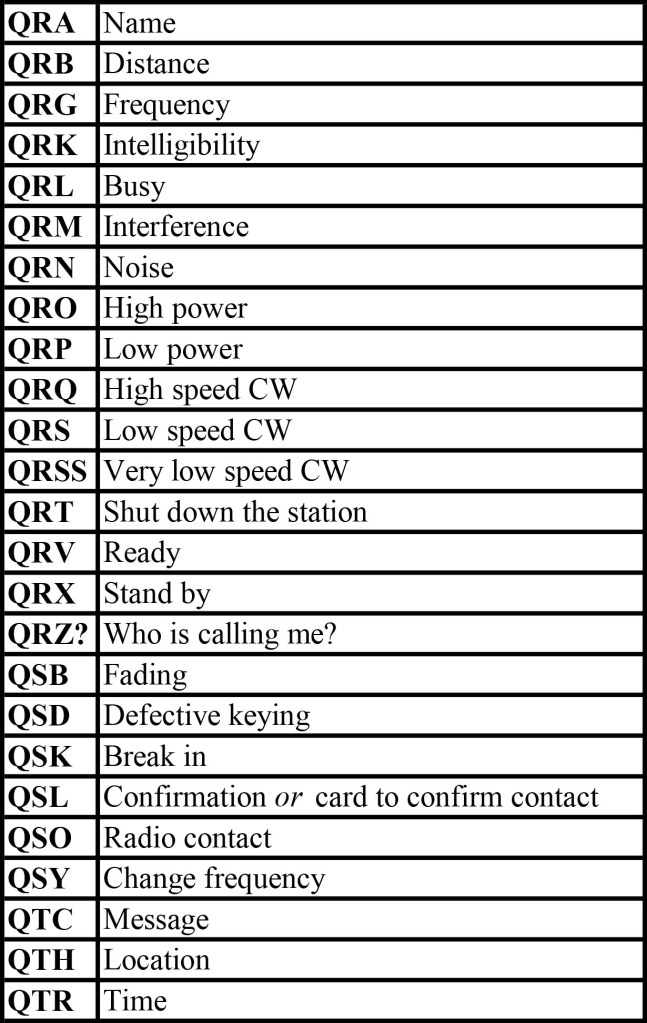
Amateur radio operators use a subset of the full international Q-code and they use it extensively still today. In many countries, learning this code is necessary to obtain a ham radio license; the exact subset used may slightly vary from country to country. Hereunder the most common codes. Sometimes Q-codes are used informally with a slightly different meaning.
Amateur radio informal Q-code
In informal ham language, some codes have slightly diverted from their original meaning and are used just as a replacement for a specific word. The table below summarizes the most common:
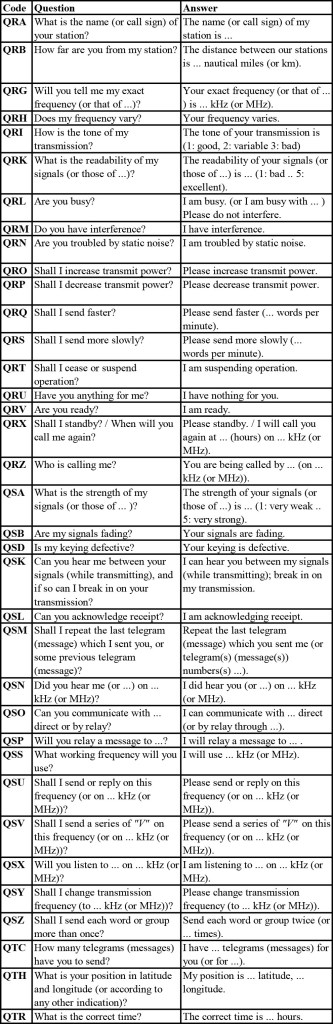
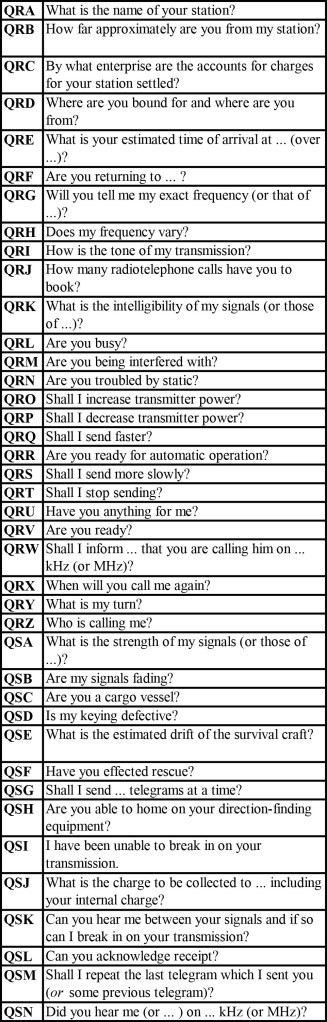
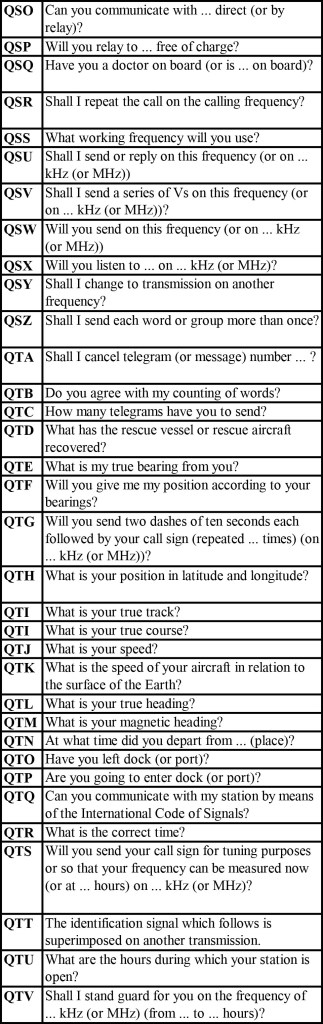
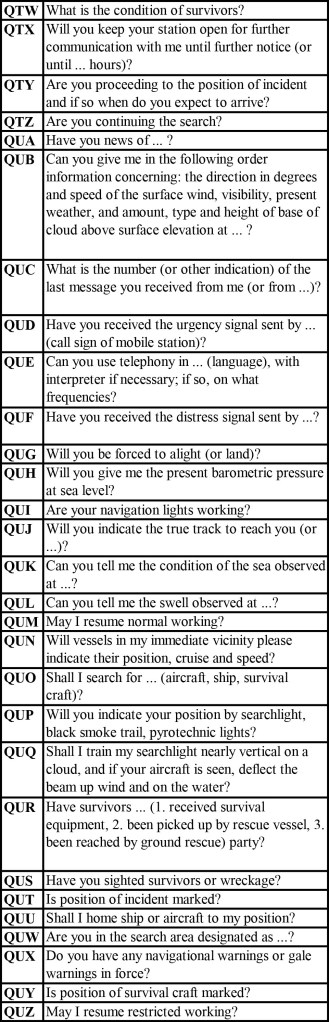
Full international Q-code
This is a more complete Q-code set that includes almost all codes from QRA to QUZ but the majority of them are for maritime/rescue use and are seldom used by amateur radio operators. Then, there are many other Q-codes from QAA to QZZ in use in aviation and maritime traffic that are out of scope here.
Here only the “question” part is shown, but it’s easy to guess the answer from the question.
Bibliography and further reading
[1]Nerio Neri I4NE. Radiotecnica per Radioamatori. C&C – Edizioni Radioelettroniche, 1994, Appendice 14. [2]OFCOM – Office fédéral de la communication. Prescriptions concernant les radioamateurs. Section concessions de radiocommunication, Rue de l’Avenir 44, CH-2503 Bienne, 2001, Appendice 3.
International Morse code today is most popular among amateur radio operators, in the mode commonly referred to as “continuous wave” or “CW”. (This name was chosen to distinguish it from the damped wave emissions from spark transmitters, not because the transmission is continuous.) Other keying methods are available in radio telegraphy, such as frequency-shift keying.
The original amateur radio operators used Morse code exclusively since voice-capable radio transmitters did not become commonly available until around 1920. Until 2003, the International Telecommunication Union mandated Morse code proficiency as part of the amateur radio licensing procedure worldwide. However, the World Radiocommunication Conference of 2003 made the Morse code requirement for amateur radio licensing optional. Many countries subsequently removed the Morse requirement from their licence requirements.
Until 1991, a demonstration of the ability to send and receive Morse code at a minimum of five words per minute (wpm) was required to receive an amateur radio license for use in the United States from the Federal Communications Commission. Demonstration of this ability was still required for the privilege to use the HF bands. Until 2000, proficiency at the 20 wpm level was required to receive the highest level of amateur license (Amateur Extra Class); effective April 15, 2000, the FCC reduced the Extra Class requirement to five wpm. Finally, effective on February 23, 2007, the FCC eliminated the Morse code proficiency requirements from all amateur radio licenses.
While voice and data transmissions are limited to specific amateur radio bands under U.S. rules, Morse code is permitted on all amateur bands—LF, MF, HF, VHF, and UHF. In some countries, certain portions of the amateur radio bands are reserved for transmission of Morse code signals only.
Because Morse code transmissions employ an on-off keyed radio signal, it requires less complex transmission equipment than other forms of radio communication. Morse code also requires less signal bandwidth than voice communication, typically 100–150 Hz, compared to the roughly 2,400 Hz used by single-sideband voice, although at a lower data rate.
Morse code is usually received as a high-pitched audio tone, so transmissions are easier to copy than voice through the noise on congested frequencies, and it can be used in very high noise / low signal environments. The fact that the transmitted power is concentrated into a very limited bandwidth makes it possible to use narrow receiver filters, which suppress or eliminate interference on nearby frequencies. The narrow signal bandwidth also takes advantage of the natural aural selectivity of the human brain, further enhancing weak signal readability. This efficiency makes CW extremely useful for DX (distance) transmissions, as well as for low-power transmissions (commonly called “QRP operation“, from the Q-code for “reduce power”). There are several amateur clubs that require solid high speed copy, the highest of these has a standard of 60 WPM. The American Radio Relay League offers a code proficiency certification program that starts at 10 wpm.
The relatively limited speed at which Morse code can be sent led to the development of an extensive number of abbreviations to speed communication. These include prosigns, Q codes, and a set of Morse code abbreviations for typical message components. For example, CQ is broadcast to be interpreted as “seek you” (I’d like to converse with anyone who can hear my signal). OM (old man), YL (young lady) and XYL (“ex-YL” – wife) are common abbreviations. YL or OM is used by an operator when referring to the other operator, XYL or OM is used by an operator when referring to his or her spouse. QTH is “location” (“My QTH” is “My location”). The use of abbreviations for common terms permits conversation even when the operators speak different languages.
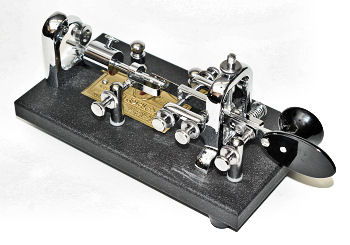
Although the traditional telegraph key (straight key) is still used by some amateurs, the use of mechanical semi-automatic keyers (known as “bugs”) and of fully automatic electronic keyers is prevalent today. Software is also frequently employed to produce and decode Morse code radio signals. The ARRL has a readability standard for robot encoders called ARRL Farnsworth Spacing that is supposed to have higher readability for both robot and human decoders. Some programs like WinMorse have implemented the standard.
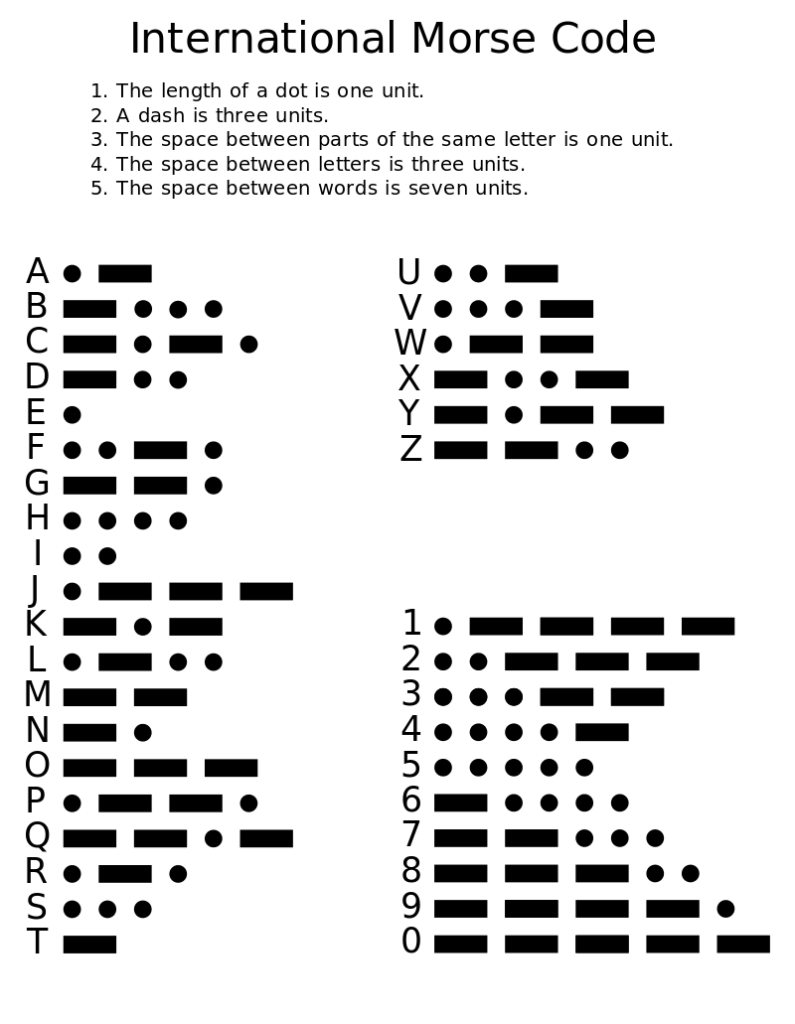
Letters
A
(dit daah)
B
(daah dit dit dit)
C
(daah dit daah dit)
D
(daah dit dit)
E
(dit)
F
(dit dit daah dit)
G
(daah daah dit)
H
(dit dit dit dit)
I
(dit dit)
J
(dit daah daah daah)
K
(daah dit daah)
L
(dit daah dit dit)
M
(daah daah)
N
(daah dit)
O
(daah daah daah)
P
(dit daah daah dit)
Q
(daah daah dit daah)
R
(dit daah dit)
S
(dit dit dit)
T
(daah)
U
(dit dit daah)
V
(dit dit dit daah)
W
(dit daah daah)
X
(daah dit dit daah)
Y
(daah dit daah daah)
Z
(daah daah dit dit)
Numbers
1
(dit daah daah daah daah)
Sometimes abbreviated with A
2
(dit dit daah daah daah)
Sometimes abbreviated with U
3
(dit dit dit daah daah)
Sometimes abbreviated with V
4
(dit dit dit dit daah)
5
(dit dit dit dit dit)
6
(daah dit dit dit dit)
7
(daah daah dit dit dit)
Sometimes abbreviated with B
8
(daah daah daah dit dit)
Sometimes abbreviated with D
9
(daah daah daah daah dit)
Sometimes abbreviated with N
0
(daah daah daah daah daah)
Sometimes abbreviated with T
Special charcaters
.
Period
(dit daah dit daah dit daah)
,
Comma
(daah daah dit dit daah daah)
:
Colon
(daah daah daah dit dit dit)
?
Question mark
(dit dit daah daah dit dit)
‘
Quote
(dit daah daah daah daah dit)
–
Hyphen or minus
(daah dit dit dit dit daah)
/
Slash
(daah dit dit daah dit)
(
Left bracket
(daah dit daah daah dit)
)
Right bracket
(daah dit daah daah dit daah)
“
Double quotes
(dit daah dit dit daah dit)
=
Equals
(daah dit dit dit daah)
+
Plus or end of message
(dit daah dit daah dit)
×
Cross
(daah dit dit daah)
SN
Acknowledgment
(dit dit dit daah dit)
K
Transmission request
(daah dit daah)
AS
Wait
(dit daah dit dit dit)
SK
End of transmission
(dit dit dit daah dit daah)
KA
Start of transmission
(daah dit daah dit daah)
Error
(*)
(dit dit dit dit dit dit dit dit)
(*) Eight or more dots.
Accented letters
è
(dit dit daah dit dit)
à
(dit daah daah dit daah)
ä
(dit daah dit daah)
ö
(daah daah daah dit)
ü
(dit dit daah daah)
ch
(daah daah daah daah)
General remarks
It’s common to express duration of Morse signals as a function of the length of a dot according to the following rules:
The length of a dash is three times the length of a dot.
The space between two signs of the same character is equal to the length of one dot.
The space between two characters of the same word is three times the length of a dot.
The space between two words is seven times the length of a dot (or more).
Of course those rules are not strict at all (especially when using a straight key) and some hams prefer using longer dashes of 3.5 or 4 dots long instead of 3.
Code speed
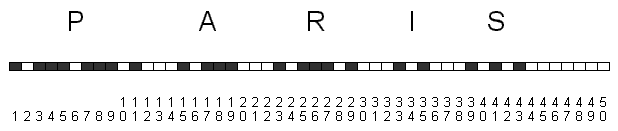
The keying speed is often expressed in words per minute (WPM), and since the length of the letters is not constant the reference word “PARIS” is commonly used:
As shown in the above diagram, considering spaces between letters after the word itself, the word “PARIS” is exactly 50 dots long, and of course is 5 letters long. Therefore a keying speed of 30 WPM (words per minute) will be equivalent to 150 LPM (letters per minute), each dot will be 40 ms long and each dash will be 120 ms long.
In order to have an idea of the speed of the code here are some examples (.wav files) of the word “PARIS” at different speeds:
OFCOM – Office fédéral de la communication. Prescriptions concernant les radioamateurs. Section concessions de radiocommunication, Rue de l’Avenir 44, CH-2503 Bienne, 2001, Appendice 5.
Discovering amateur radioWelcome to amateur radio.
What is amateur Radio? Its the best fun ever if you’re even slightly technically minded! It’s also a service in which you, the radio amateur, or ham, can play a part in helping with recovery from disasters such as floods, earthquakes and typhoons by using your own radio equipment and antennas to communicate with first responders and government agencies whose own communications have been knocked out.
When cell phone towers topple then amateur radio is usually the only way to communicate from the stricken areas for the first few days after a disaster. Many “hams” also give service by working within their communities to help during charity fun runs, for example, using their portable vhf radios to communicate trouble spots and assist medical teams to efficiently cover a particular area, or during Easter week to help out their kababayans on the road as they travel to and from the provinces, by setting up base stations along the way.
Of course it’s not all service and duty, those are optional. Many hams enjoy talking to distant stations in other countries and other continents using various modes such as Morse code, digital modes, even TV, not just using a microphone, and many just enjoy simple “ragchewing’, chatting away on the 2m band. The options are almost endless and only limited by your imagination.
Think about contacting another ham station on the other side of the world by using the moon to reflect your signals! Some hams have even received signals from Mars probes! On the other side of the scale, many hams enjoy using very low power to communicate all over the world.
PARA has it’s own radio station at the 4th floor of the National Telecommunications Commission Central Office in Quezon City and you are welcome to drop in during the week and perhaps operate the PARA ham radio station. If you do not yet have an Amateur Radio license, Dolly or Gilbert will assist you with information about how to study and pass the NTC licence test. It’s not difficult as many non technically minded people have passed with flying colors after attending the seminar and studying the supplied materials. There is now a Novice licence which is very easy to pass and allows operation on the popular 2m (144 MHz) band.
Wherever you live in the Philippines there is usually a ham club nearby with friendly members who will assist you in your endeavors to study and become a ham radio operator. Many clubs hold seminars for potential hams, so contact PARA to find out more.
You may get in touch with us at the following address:
Philippine Amateur Radio Association 4th Flr. NTC Building, Agham Road, Quezon City Telephone: +63 2 668 9125 Email: para1932@gmail.com
The Radio Amateur’s Code
The Radio Amateur is
CONSIDERATE
…never knowingly operates in such a way as to lessen the pleasure of others.
LOYAL
…offers loyalty, encouragement and support to other amateurs, local clubs, the Philippine Amateur Radio Association (PARA), Inc., through which Amateur Radio in the Philippines is represented nationally and internationally.
PROGRESSIVE
…keeps station up to date. It is well-built and efficient. His operating practice is above reproach.
FRIENDLY
…operates slowly and patiently when requested; offers friendly advice and counsel to beginners; kind assistance, cooperation and consideration for the interests of others. These are the marks of the amateur spirit.
BALANCED
…Radio is a hobby, never interfering with duties owed to family, job, school or community.
PATRIOTIC
…station and skills are always ready for service to country and community.
– adapted from the original Amateur’s Code, written by Paul M. Segal, W9EEA, in 1928


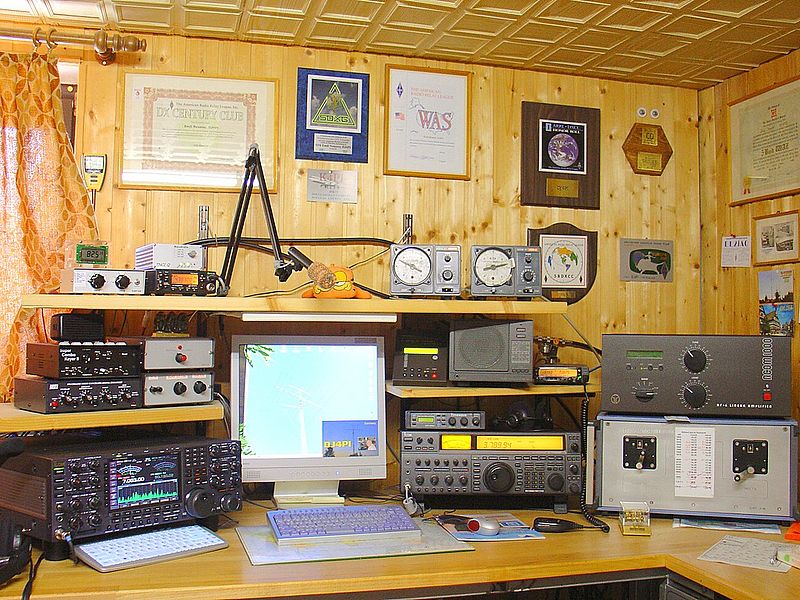
 4H1FOC Amateur Radio Station